

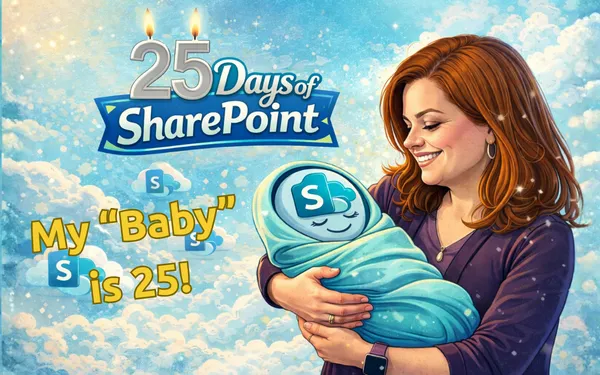
My Baby is Growing Up!
I’ve been thinking about this a lot lately, and I’ve decided the only way to say it honestly is this: watching SharePoint turn 25 feels a lot like watching your kid grow up.
You remember them as a baby. A little awkward. Full of potential. Needing a lot of guidance. And absolutely not ready to be left alone with the keys.
I met SharePoint as an infant, before it’s parents even decided on the name SharePoint. Back then, it was all portals and document libraries, and we were doing our best to explain to people why this thing mattered.

Then it was an awkward little toddler, bumping into furniture and wasn’t really sure how those limbs work. But even then, you could tell it was trying to do something big. It wanted to bring people together. It wanted to organize the chaos. It just needed time to grow into itself.
And grow it did.
Watching SharePoint Grow Up
When SharePoint was just a few years old, it was learning the basics. How to store files. How to give teams a shared space. How to exist in organizations that were still very attached to network drives and email attachments. It was earnest, but let’s be honest, it needed supervision.

When SharePoint hit its teenage years, things got interesting. Collaboration became a real conversation. Team sites mattered. Workflows started to show up. Customization exploded, sometimes in wonderful ways and sometimes in ways we all regret a little. SharePoint was experimenting, finding its voice, and occasionally making messes we had to clean up later.
Then came early adulthood.
I say that because, who at 18 is truly prepared to be an adult?
When SharePoint was in its late teens and early twenties, it found its stride. Modern sites arrived. Pages became visual and flexible. Intranets stopped looking like filing cabinets and started feeling like front doors. SharePoint learned how to play well with others, especially across Microsoft 365, showing up inside Teams, powering Viva, and becoming the hub for modern work.
The Momma Bear
All along the way I had to be the protective parent, standing between SharePoint and a very opinionated world that was not always kind. People called it ugly. They blamed it for bad design decisions it didn’t make. They judged it by environments that were poorly planned, over-customized, or launched without a single thought about the people who had to use it every day. I can’t count how many meetings I sat in defending it, explaining that SharePoint wasn’t the problem, the approach was. That if you give it no structure, no guidance, and no training, of course it’s going to struggle.

But when it’s supported, designed with intention, and paired with learning, it shines. Every protective parent knows that moment. You don’t pretend your kid is perfect, but you absolutely make sure they get a fair chance to show what they’re capable of. Quit calling my baby UGLY!
Then Teams and OneDrive came along. “Oh, We Love OneDrive, We Love Teams”. Really people? Now? The snarky side of me wants to yell..."Suck it…IT’S ALL SHAREPOINT!"
And now, at 25, SharePoint is a bit more mature. It’s confident. It’s powerful. It knows what it’s good at. And it quietly runs more organizations than most people realize. (Spoiler alert - Nothing lives in Teams!)
People are starting to trust it (and maybe more if things would quit being moved around!)
Why I’m Doing the 25 Days to SharePoint Countdown
To celebrate this milestone, I’m launching a 25-day countdown to SharePoint’s 25th birthday on March 2nd, leading right up to the official birthday celebration event hosted by Microsoft.
This series is my love letter, proud-parent edition.
Over the next 25 days, I’ll be sharing short blog posts that highlight the SharePoint features and moments that shaped how we work today. Each post will focus on a specific capability and the real-world problem it helped solve, because SharePoint’s story isn’t about features for the sake of features. It’s about evolution.
We’ll talk about:
The features that helped SharePoint find its footing.
The moments that built trust with users.
The shifts that turned it into the backbone of collaboration.
And the quiet, grown-up responsibilities it handles today, from governance to automation to search.
This isn’t a technical deep dive. It’s a guided walk through the moments that mattered, told by someone who’s been there through every growth spurt.
A Little Pride, A Lot of Perspective
I’ve implemented SharePoint at every stage of its life. I’ve trained users who met it as a toddler and users who only know the confident adult version. I’ve watched organizations struggle when SharePoint wasn’t ready and absolutely thrive when it was paired with the right learning and adoption strategy.

That’s why this countdown matters to me. SharePoint didn’t just grow up on its own. It grew up alongside the people who used it, taught it, supported it, and sometimes defended it in meetings when things got tough.
Seeing it turn 25 feels like standing in the back of the room, arms crossed, smiling, and thinking,
“Look at you now.”
Because SharePoint didn’t just grow up.
It grew into something remarkable.
And it’s not done yet.


